Most people fly to Athens and head for the islands. The ones who drive south — all the way south, past Sparta, past Gytheio, into the Mani — tend not to come back the same.
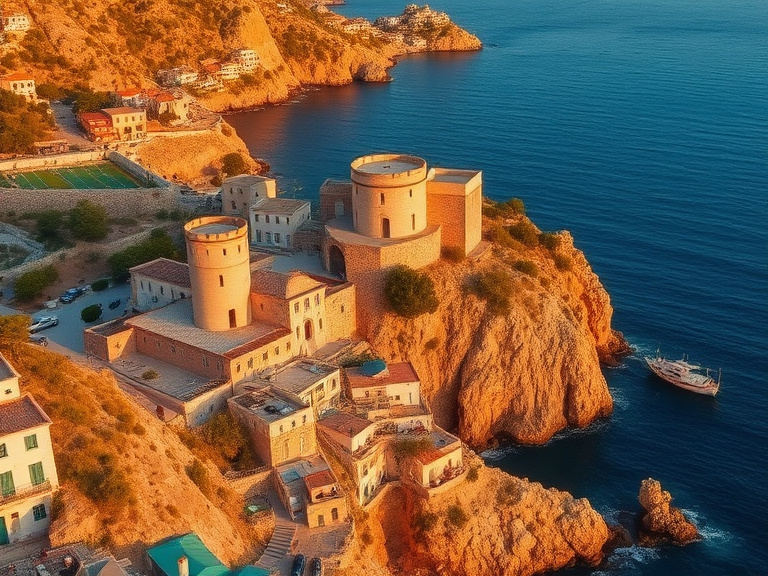
There is a moment, driving into the Deep Mani for the first time, when the landscape changes so completely that you slow down without thinking about it. The olive trees thin out. The road narrows. And then you see them — the towers. Stone fingers rising from the hillsides, twenty, thirty metres high, built by families who fought each other for centuries in a place too wild and remote to be governed by anyone else.
This is Mani. And almost nobody outside Greece knows it exists.
Where exactly is Mani?
Mani is the middle of three peninsulas that extend from the southern Peloponnese into the Mediterranean. It is divided into two parts: the Exo Mani (Outer Mani) in the north, which is greener and more accessible, and the Mesa Mani (Deep Mani) in the south, which is where things get really interesting.
The southernmost point of the peninsula — and the southernmost point of mainland Greece — is Cape Tainaron. In ancient Greek mythology, one of the entrances to the Underworld was here. Standing at the cape on a clear day, with nothing between you and North Africa, it is easy to understand why.
The tower villages
The defining image of Mani is the pyrgospita — the tower house. Between the 17th and 19th centuries, the Maniots built these towers as weapons. Families fought blood feuds that lasted generations, using the towers to gain height advantage over their enemies.
The village of Vathia, perched on a hilltop in the Deep Mani, is the most photographed — a cluster of towers silhouetted against the sky, half-abandoned, extraordinary. Most of the villages are quiet now. The population of the Deep Mani has dropped dramatically over the last century. What is left is one of the most atmospheric and photogenic landscapes in Europe, largely undiscovered.
Diros Caves — one of the great natural wonders of Greece
The Diros Caves are a vast underground lake system near the village of Pyrgos Dirou. You navigate them by rowing boat — a guide punts you through low stone arches, through chambers of stalactites reflected in perfectly still black water, past prehistoric formations that took millions of years to grow.
It takes about 45 minutes. It is completely unlike anything else you will experience in Greece. Book ahead — the cave operates with timed entry and fills up in summer. Adjacent to the cave system, archaeologists have found evidence of human habitation going back to the Neolithic period. The small museum above the cave entrance is worth twenty minutes.
Limeni — lunch at the water’s edge
Limeni is a small village on a sheltered bay in the Outer Mani. The water is impossibly clear — turquoise shading to deep blue in the middle of the bay, with the village rising up the hillside behind. There are a handful of tavernas on the waterfront. Sit outside, order whatever the kitchen has that day, and spend two hours doing nothing in particular.
This is the kind of place that does not photograph well. You have to be there.
Cape Tainaron — the end of the earth
The drive to Cape Tainaron takes you to the very tip of the peninsula, past the lighthouse and down a gravel track to the cape itself. A fifteen-minute walk from the car park brings you to a ruined ancient temple, a sea cave that the ancients believed led to Hades, and a view of open water in three directions.
There is almost nothing here. No café, no signs, no facilities. Just the wind, the sea, and the sense of being at the edge of something.
The coastal road
The road along the eastern coast of the Deep Mani — from Areopoli south to Gerolimenas and around to Porto Kayio — is one of the great drives in the Peloponnese. The landscape is stark and beautiful: grey-green scrub, rocky hillsides dropping to turquoise coves, the occasional tower village visible on a ridge above.
Stop at Gerolimenas, a tiny harbour that functions as the de facto capital of the Deep Mani. A handful of hotels, a couple of tavernas, the sea. It is a good base for two nights.
When to visit
September and October are ideal. The summer heat has broken, the sea is still warm, and the crowds — never large in Mani anyway — have thinned. Spring (April and May) is beautiful: the wildflowers are out across the hillsides and the light is extraordinary.
July and August are hot and dry. The landscape becomes almost lunar. Some people love it for exactly that reason.
Mani as part of a Peloponnese journey
Mani works best as part of a larger route through the Peloponnese. Two nights here — one full day to explore, one to slow down — is the minimum. Come from Monemvasia in the east or Kalamata in the west. Both are beautiful approaches.
This is one of the reasons we built TheLocals around hub-based travel. Two nights in Mani, sleeping in the same place, with a car and a curated set of experiences, gives you something that a single-night stopover never can.
Experience Mani with TheLocals
TheLocals was built for exactly this kind of travel — curated routes through the Peloponnese with handpicked places to stay, local experiences, and a car to connect everything. Mani is one of our favourite hubs. We know it well.
If you want to visit Mani as part of a designed journey rather than a searched one, this is what we do.
Plan your journey →“The Mani is the part of Greece the guidebooks always forget. The people who find it tend not to tell anyone about it.”